


0 Comments
Beyond the AI Request: How Consultative Discovery Reveals What Really Needs Solving
Consultative Discovery | AI Enablement | Operational Improvement
When a business asks how AI can solve an operational problem, the most valuable first step may not be selecting an AI solution. It may be understanding what is actually happening across the business.
This article follows an initial production-planning enquiry through structured stakeholder conversations, operational workflow investigation and evidence-led opportunity qualification.
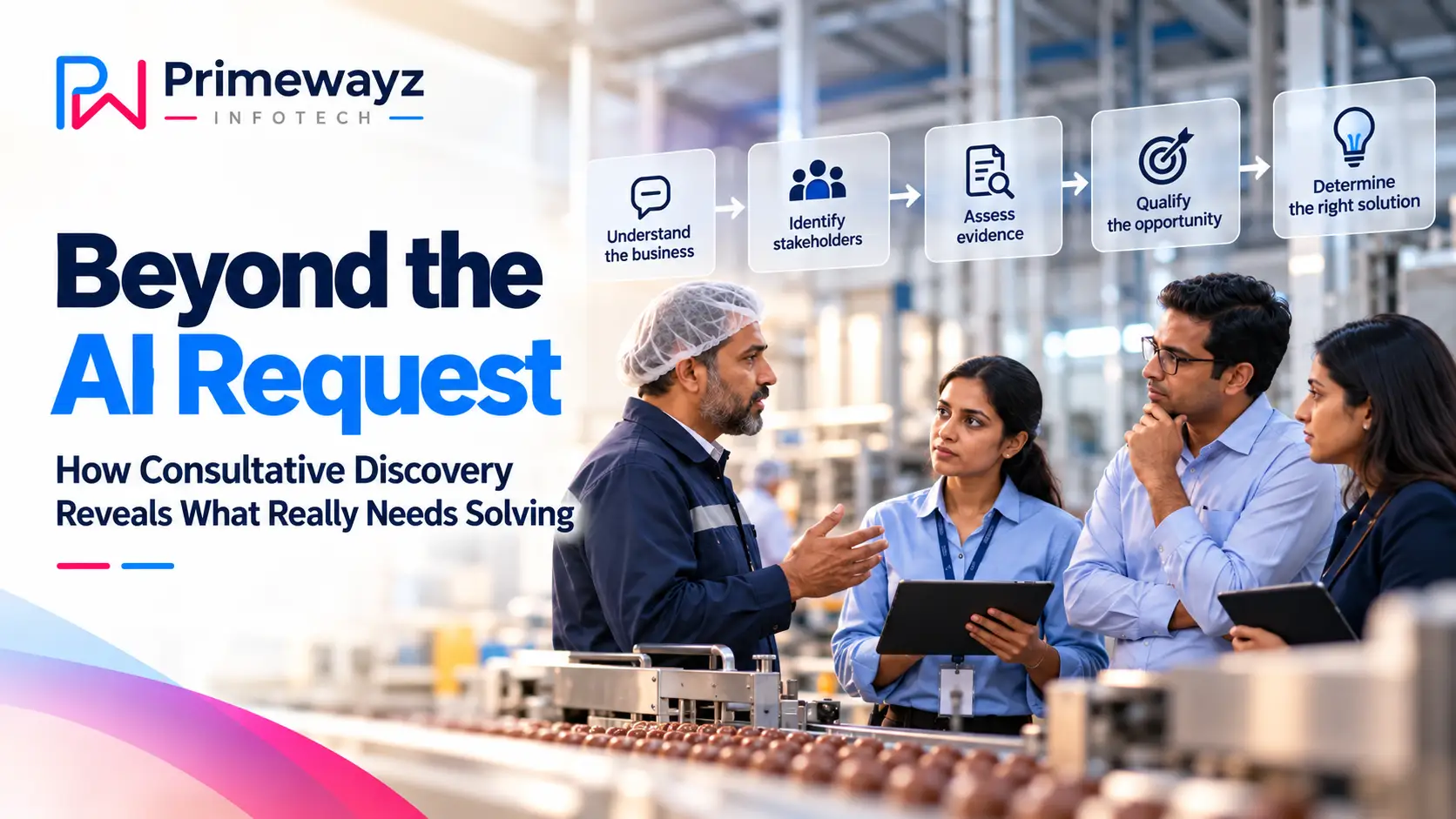
before selecting technology.
The customer and the initial problem statement
Antara Confectioneries is an established business specialising in the production and retail of fresh Indian sweets and snacks, including dried namkeen items, with production facilities supplying multiple retail outlets.
The discussion began with a concern raised by the factory manager. Some outlets were experiencing product shortages, while others were left with unsold stock. The initial request was to explore whether AI-assisted production planning could improve the situation.
It was a reasonable technology question. But before discussing AI, we needed to understand the business problem it was expected to solve.
We initiated the process with the Primewayz OpenAI Certified Consultative Solutions Partner (POCCS), beginning with the factory’s existing planning workflow.
Where do production requirements come from?
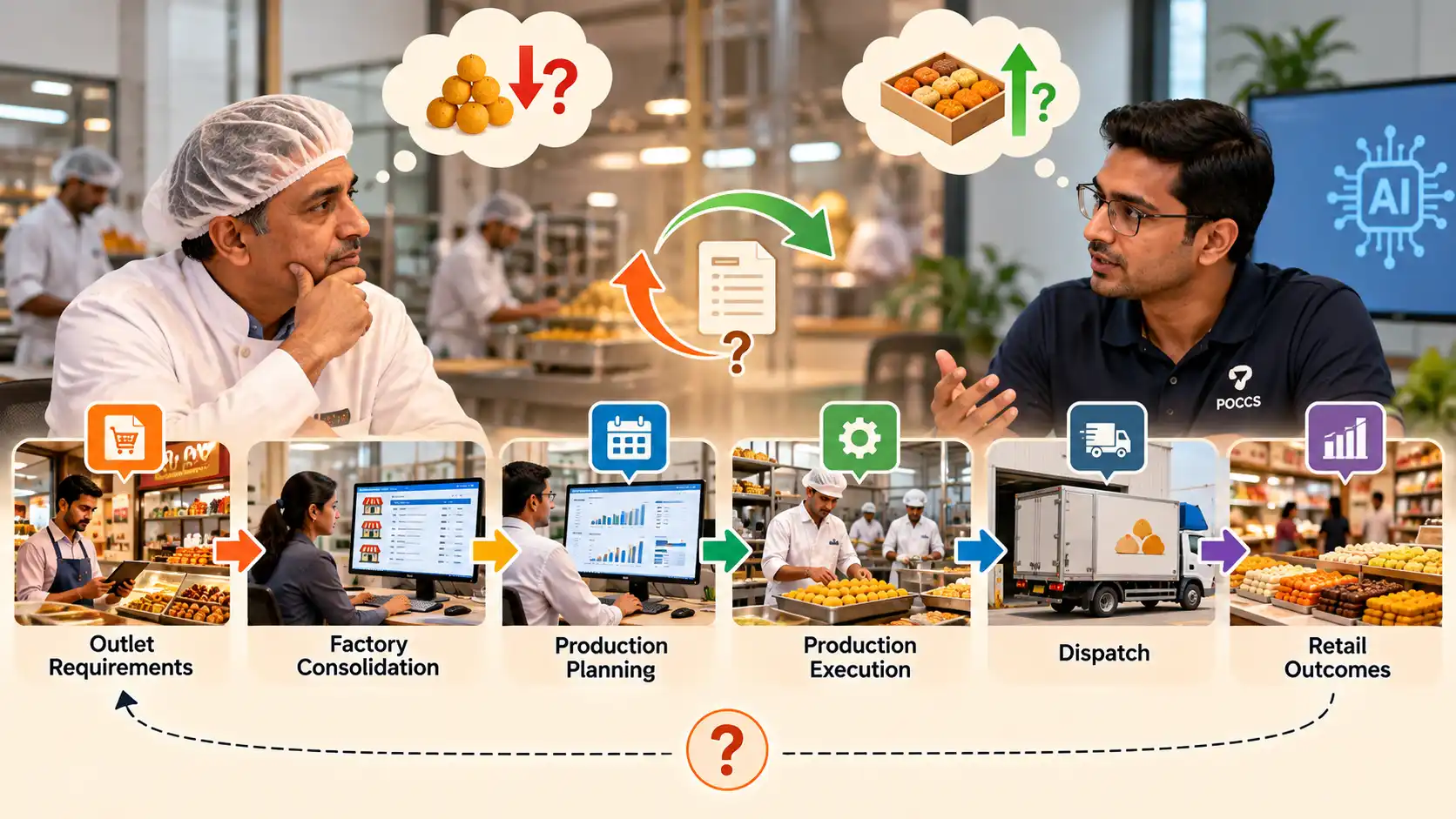
POCCS: Before we discuss how AI could improve planning, could you walk us through how the factory decides what to produce for each outlet?
Factory Manager: The factory needs to know what quantities are required for each outlet and prepare production accordingly.
POCCS: So the outlet requirement is an important input. How is that quantity determined? Is it based on previous sales, stock remaining at the outlet, expected demand or a decision made by the outlet team?
Factory Manager: Those are the kinds of inputs we would need to examine. The important thing is that the factory receives requirements it can plan against.
POCCS: Understood. Then we should follow a requirement from the outlet through consolidation, production planning, execution and dispatch, and compare it with what eventually happens at the outlet.
This gave the investigation its first boundary. The issue was not simply how the factory calculated production quantities. We needed to understand how demand information entered the process and how that information became an operational commitment.
That sequence also exposed a question worth pursuing: what happens when the information changes after the factory has already planned production?
Is a changed requirement necessarily a problem?
POCCS: Suppose an outlet submits its requirement and later asks for a different quantity. How would the factory handle that?
Factory Manager: That would depend on when the change arrives and whether production can accommodate it.
POCCS: Exactly. A change received before production begins is different from one received after preparation is underway. Do we distinguish between those situations when reviewing shortages or excess stock?
Factory Manager: We would need to look at individual cases to understand the difference.
POCCS: Then counting how many times requirements change may not tell us enough. We need to know which changes are accommodated, which cannot be accommodated and whether either situation actually affects the outlet.
Consider two possibilities
Situation A: An outlet increases its requirement after the schedule is prepared, but the factory has sufficient capacity and materials to produce the additional quantity. The revision creates no significant disruption.
Situation B: An increase arrives after production has progressed beyond the point where the quantity can reasonably be changed.
The second situation might result in an unmet requirement. But it would still be premature to call that a planning failure.
POCCS: So our next question is not simply whether requirements change. It is who decides whether a change can be accepted, and on what basis.
That brought the production supervisor’s role into focus.
Who decides what can actually be produced?
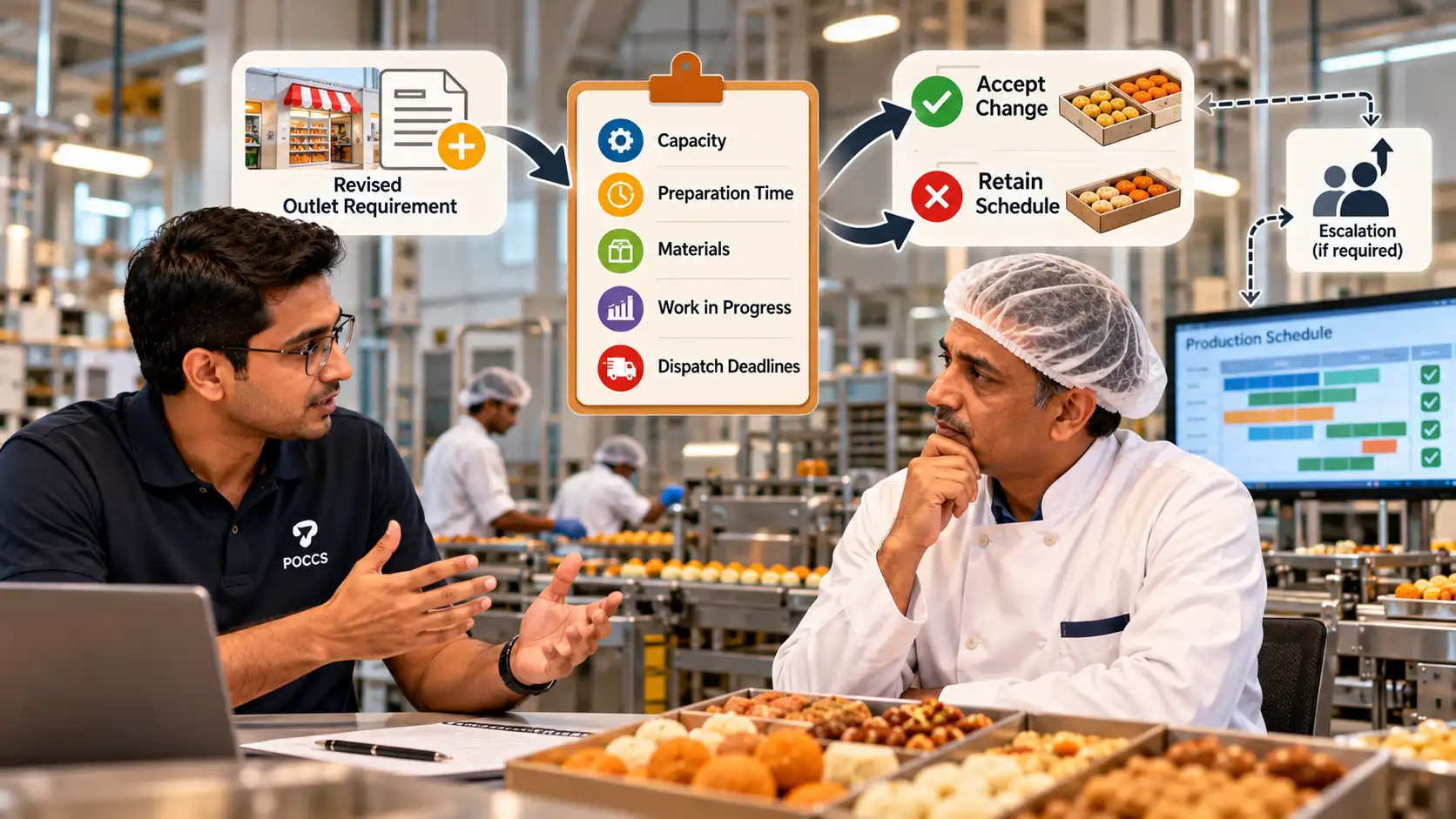
The factory manager oversees the planning process, but the production supervisor is closer to the decisions made during execution.
POCCS: When a revised requirement reaches production, what would the supervisor need to consider before accepting it?
Production Supervisor: The decision would depend on practical constraints, such as available capacity, preparation time, materials, work already underway and dispatch deadlines.
POCCS: And if the additional quantity cannot be produced, who has the authority to retain the existing schedule or approve an adjustment?
Production Supervisor: That depends on the decision responsibilities and escalation process in place.
POCCS: Then we need to examine both the constraint and the decision. Otherwise, we might classify a justified production decision as an avoidable failure.
Imagine an outlet requests an additional quantity, but production is already underway and the dispatch deadline cannot be extended. Declining the change may be the correct operational decision.
Now consider a different situation: the original requirement was approved, but the planned quantity was not produced because information was incomplete or a necessary decision was delayed.
The final outcome could look similar, yet the underlying problems would be different.
POCCS: If we examine a production shortfall later, can we reconstruct what the supervisor knew, which constraints applied, who made the decision and what was communicated to the outlet?
That question moved the investigation beyond general explanations. We now needed operational evidence.
What do the records actually tell us?
A convincing explanation is not necessarily a verified explanation.
We therefore introduced a more specific exercise: select representative production exceptions and trace them from the original requirement to the retail outcome.
POCCS: Let us take a day when an outlet did not receive the expected quantity. What records would help us reconstruct the event?
Factory Manager: We would need the outlet requirement, the production plan, actual production and dispatch details.
POCCS: And if the requirement was revised, we would also need the revision timing, the decision taken and the reason behind it.
Production Supervisor: That would help distinguish between a changed requirement and a production constraint.
POCCS: We should also compare what was dispatched with what the outlet received and subsequently sold. A production shortfall, a dispatch difference and an outlet stockout are not necessarily the same event.
The proposed evidence review
- Original and revised outlet requirements
- Approved production schedules
- Actual production quantities
- Decisions and relevant operational constraints
- Dispatch and receipt records
- Outlet sales, shortages, returns and unsold stock
The objective was not to gather every available report. It was to reconstruct a small number of meaningful exceptions well enough to test competing explanations.
Example: If shortages occurred even when outlet requirements had not changed, late revisions could not explain every exception.
That would require the investigation to consider other dependencies. One possible dependency was material availability.
When does procurement become part of the problem?
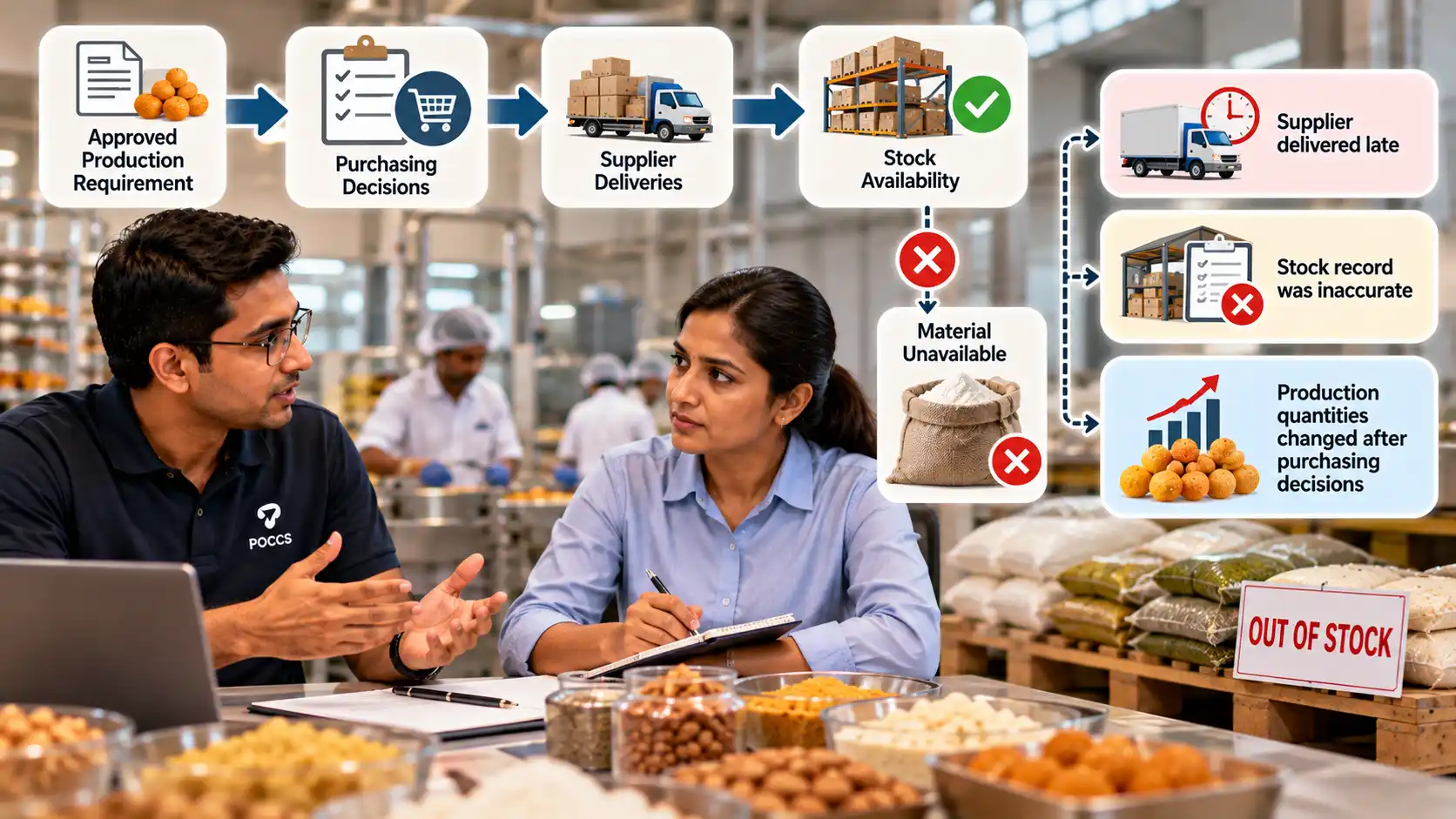
A factory cannot produce the required quantity if an essential material is unavailable at the required time. But material unavailability is an outcome that can have several explanations.
POCCS: Suppose production could not meet an approved requirement because a material was unavailable. How would we establish why that happened?
Procurement Representative: We would need to compare the production requirement with purchasing decisions, supplier deliveries and stock availability.
POCCS: Would the explanation be different if the supplier delivered late, the stock record was inaccurate or production quantities changed after purchasing decisions had been made?
Procurement Representative: Yes. Those situations would involve different information and responsibilities.
POCCS: Then we should not treat every material shortage as a procurement failure. We need to trace the specific exception to the information and decisions that preceded it.
If the supplier delivered late against an agreed schedule, the investigation might point towards supplier reliability or purchasing controls.
If materials were physically available but the records were inaccurate, the issue might involve inventory visibility.
If purchasing had been completed against an approved production plan that subsequently changed, the underlying problem could lie elsewhere.
Each explanation would suggest a different corrective action.
The appropriate next step was a targeted review of production requirements, purchase orders, goods receipts and stock records, but only for exceptions where material availability appeared relevant.
The investigation was expanding across functions, not because every department needed a technology solution, but because the original operational outcome could depend on decisions made in several places.
That raised a management question: Who was accountable for improving the outcome across the entire workflow?
Who owns the business outcome?
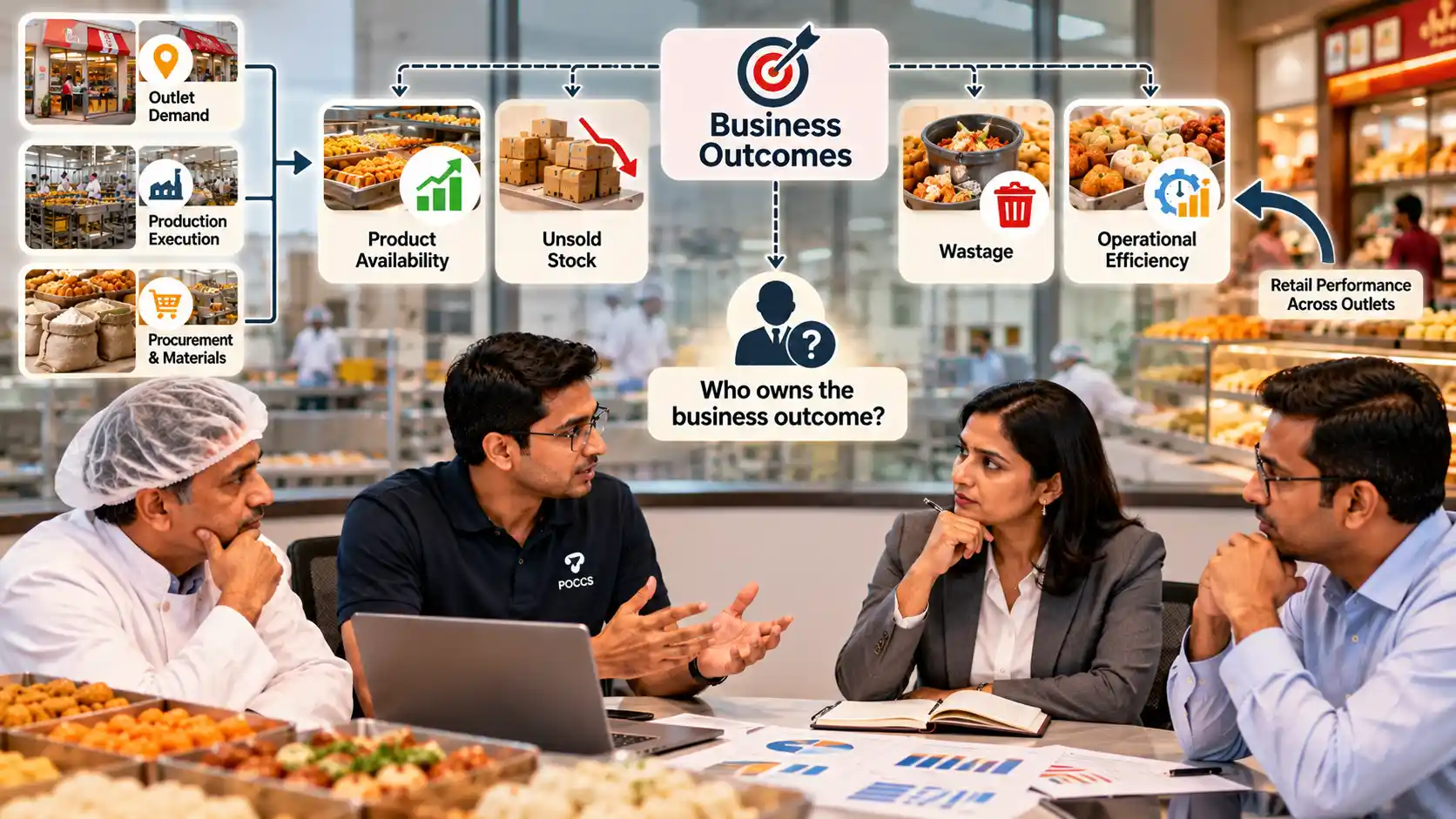
The factory manager could explain production planning. The supervisor could explain execution decisions. Procurement could account for purchasing and material availability.
But the original concern involved two wider outcomes: product shortages and unsold stock across outlets. Neither belonged exclusively to one function.
POCCS: We have been examining how different teams influence the result. From management’s perspective, which outcome needs the greatest improvement: product availability, unsold stock, wastage, operational efficiency or a combination?
Operations Leadership: That would need to be established against the business’s priorities and current performance.
POCCS: How are those outcomes measured today? For example, do we distinguish unsold stock from actual wastage, and an unmet outlet request from a lost sale?
Operations Leadership: Those measures would need clear definitions before comparing performance.
POCCS: And if an exception involves outlet demand, production and procurement, who is accountable for coordinating an improvement rather than addressing only one department’s part of the process?
This is where consultative discovery moves from operational symptoms towards business ownership.
A production supervisor may be responsible for executing an approved schedule without owning the organisation-wide balance between availability and wastage.
Likewise, procurement may own purchasing decisions without owning the retail outcome.
An improvement initiative requires both:
- Process owners who understand and control individual activities.
- An accountable outcome owner who can prioritise the business problem, coordinate the functions involved and approve the next stage.
Without that accountability, even a technically successful solution may struggle to produce a measurable business improvement.
Is the problem significant enough to justify investment?
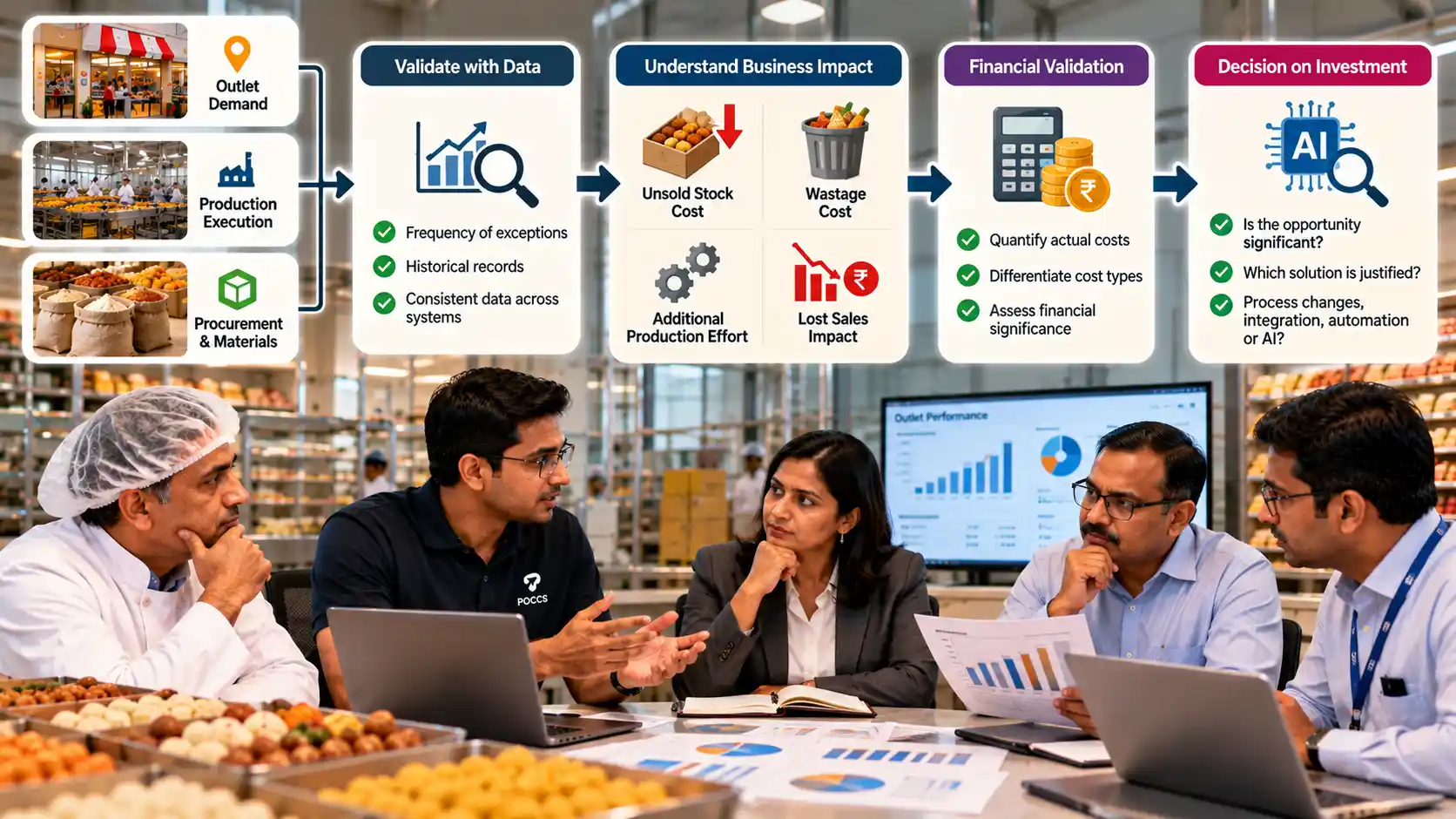
By this point, several possible contributing factors had been identified for investigation. But identifying plausible causes is not the same as establishing a commercially meaningful opportunity.
POCCS: Before evaluating solutions, can we determine how frequently these exceptions occur and what they cost the business?
Operations Leadership: We would need a representative period of operating records and appropriate measures.
POCCS: Then we should involve Finance to validate the financial implications. Unsold stock, wastage, returns, additional production effort and lost sales cannot automatically be treated as equivalent costs.
POCCS: We should also confirm whether IT can provide consistent records across the relevant systems, and whether access approvals or quality controls affect the proposed review.
The purpose was not to assemble a large project team. It was to involve the people who could validate the evidence, confirm accountability and authorise the next decision.
Only after that assessment could we judge whether the improvement opportunity justified process changes, system integration, automation or AI.
This distinction is especially relevant when organisations evaluate broader digital transformation and software engineering capabilities. The technology decision should follow a sufficiently clear understanding of the operational requirement.
What the discovery process needs to produce
A useful consultative engagement should not end with a long collection of questions or meeting notes.
It should produce a concise record that allows someone outside the conversations to understand the business concern, the evidence, the ownership and the next decision.
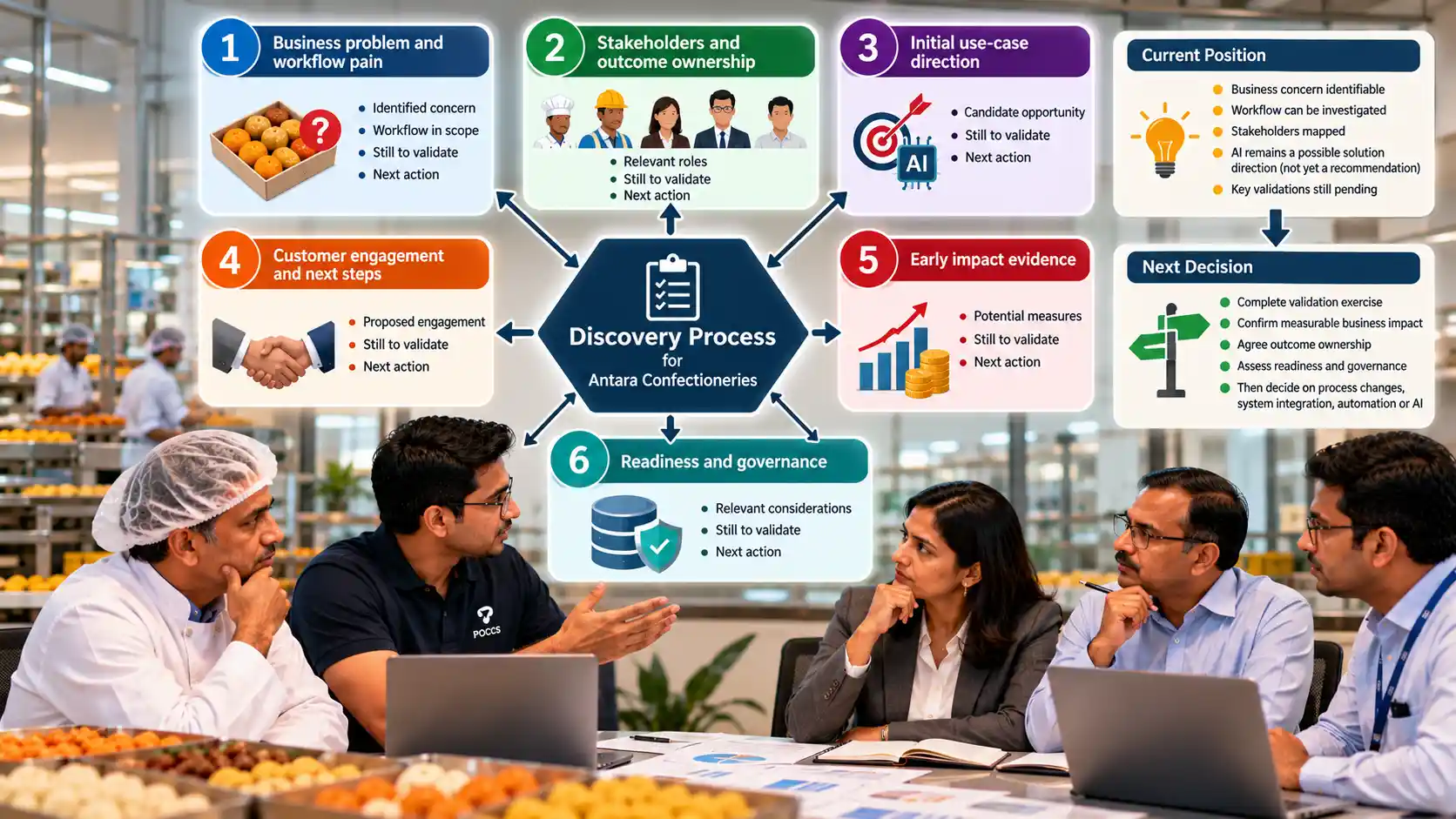
For Antara Confectioneries, the current discovery record can be organised into six dimensions.
01. Business problem and workflow pain
Identified concern: Product availability and unsold stock, initially raised in the context of factory production planning.
Workflow in scope: Outlet requirements through planning, production, dispatch and retail outcomes.
Still to validate: Where exceptions originate, how frequently they occur and which causes are supported by records.
Next action: Reconstruct representative exceptions across the workflow.
02. Stakeholders and outcome ownership
Relevant roles: Factory management, production supervisors, outlet operations and procurement, with operations leadership involved in business outcome ownership.
Still to validate: The accountable outcome owner, decision authorities and cross-functional responsibilities.
Next action: Confirm ownership and the people authorised to participate in the review.
03. Initial use-case direction
Candidate opportunity: Reduce avoidable exceptions affecting production fulfilment and outlet outcomes.
Still to validate: Which exception patterns are recurring, preventable and material.
Next action: Evaluate the contributing factors before selecting any intervention.
04. Customer engagement and next steps
Proposed engagement: A focused, cross-functional operational evidence review.
Still to validate: Customer agreement, scope, participants, record availability and timing.
Next action: Obtain a clear commitment to the validation exercise.
05. Early impact evidence
Potential measures: Product shortages, unsold quantities, wastage, fulfilment delays, additional effort and production disruption.
Still to validate: Frequency, financial significance and causal relationships.
Next action: Agree on measurement definitions and validate representative operating and financial records.
06. Readiness and governance
Relevant considerations: Data availability, consistency across functions, decision approvals, access permissions and applicable quality controls.
Still to validate: Whether the required evidence is accessible and sufficiently reliable.
Next action: Confirm data ownership, access arrangements and governance responsibilities.
Where does this leave the AI opportunity?
The engagement began with an interest in AI-assisted production planning. At the present stage, that remains a possible solution direction, not a qualified recommendation.
The business concern is identifiable. The operational workflow can be investigated. Relevant stakeholders and potential evidence sources can be mapped.
However, the dominant causes, measurable impact, accountable outcome owner and customer commitment to further validation have not yet been established.
Current opportunity assessment
Developing, Stage 0 candidate
Next decision: whether the customer and Primewayz should proceed with a focused operational evidence review.
That means the next decision is not which AI model to use or which forecasting platform to implement.
A suitable review would trace selected exceptions across outlet requirements, production decisions, material availability, dispatch and retail outcomes.
The expected result would be a validated problem statement, an assessment of recurring contributing factors, agreed business measures and confirmed accountability.
Only then should the solution options be compared.
The eventual recommendation might involve better demand inputs, improved production coordination, clearer decision controls, integration between existing systems, workflow automation or AI-assisted planning.
It might also establish that the business needs process improvements before additional technology.
The value of the conversation
What makes consultative discovery valuable is not the number of questions asked.
It is how each answer changes the next question.
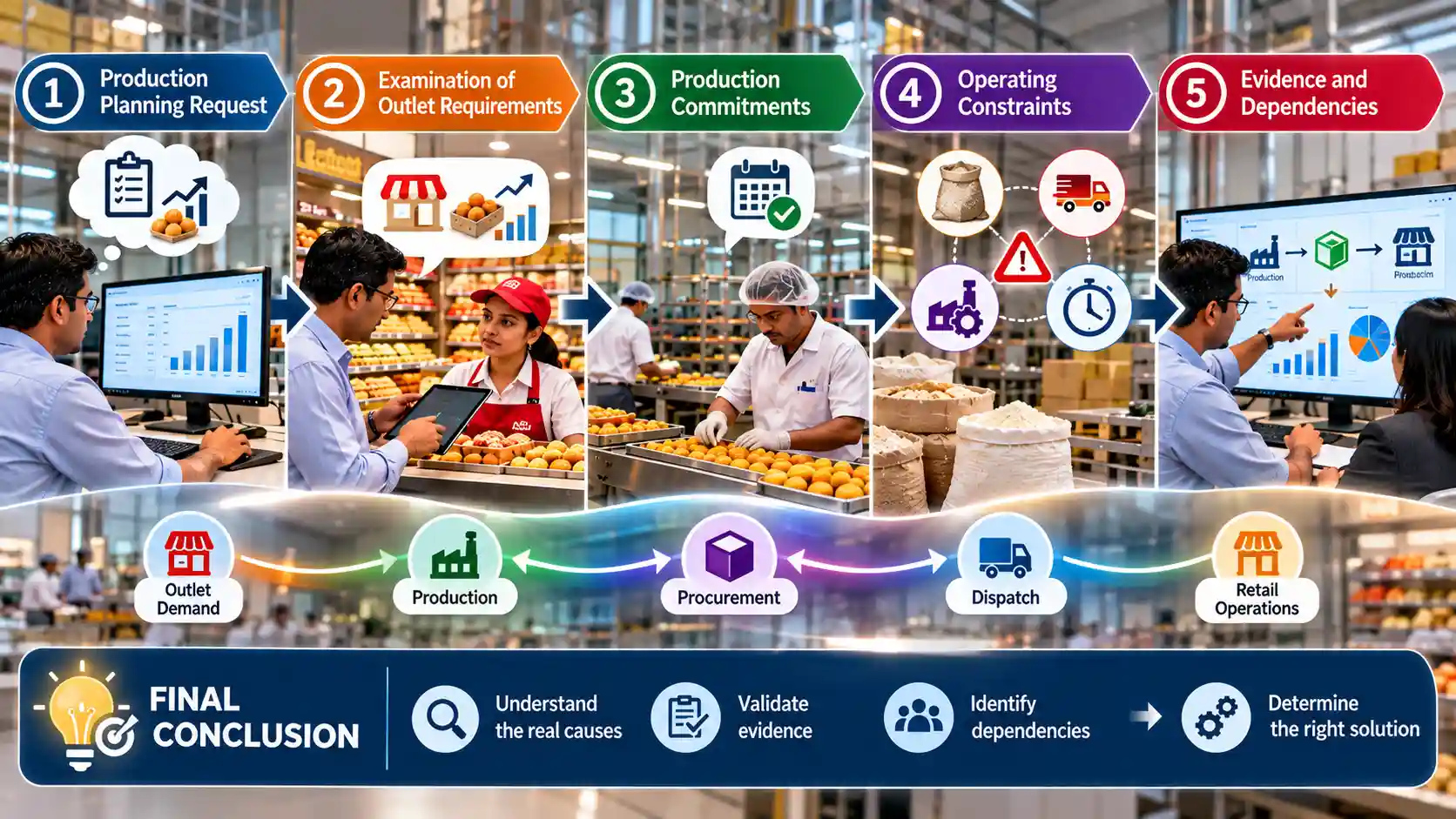
A production-planning request leads to an examination of outlet requirements. That exposes the importance of revisions and production commitments. Those decisions bring operating constraints into consideration.
Testing those explanations requires evidence, which may reveal dependencies across production, procurement and retail operations.
The investigation then reaches the questions that determine whether an opportunity is worth pursuing:
What business outcome matters?
Who owns it?
How will improvement be measured?
What evidence supports the proposed intervention?
For Primewayz, the purpose of the Consultative Solutions Process is to make that progression visible and actionable.
The goal is not to turn every AI request into an AI project. It is to establish which business problem deserves to be solved, what evidence supports it and which response is justified.
That is where a credible solution engagement begins.