
Keep Salesorder as the transactional authority
Orders, inventory, allocations, purchase orders, customer rules and fulfilment states remain authoritative in existing application services.



Salesorder AI enablement adds a governed investigation layer to wholesale ERP operations. It assembles authoritative order, inventory, warehouse, incoming-stock and customer-rule evidence, validates blockers with deterministic rules, explains the result, and prepares only permitted resolution options while authorised users retain control of ERP actions.
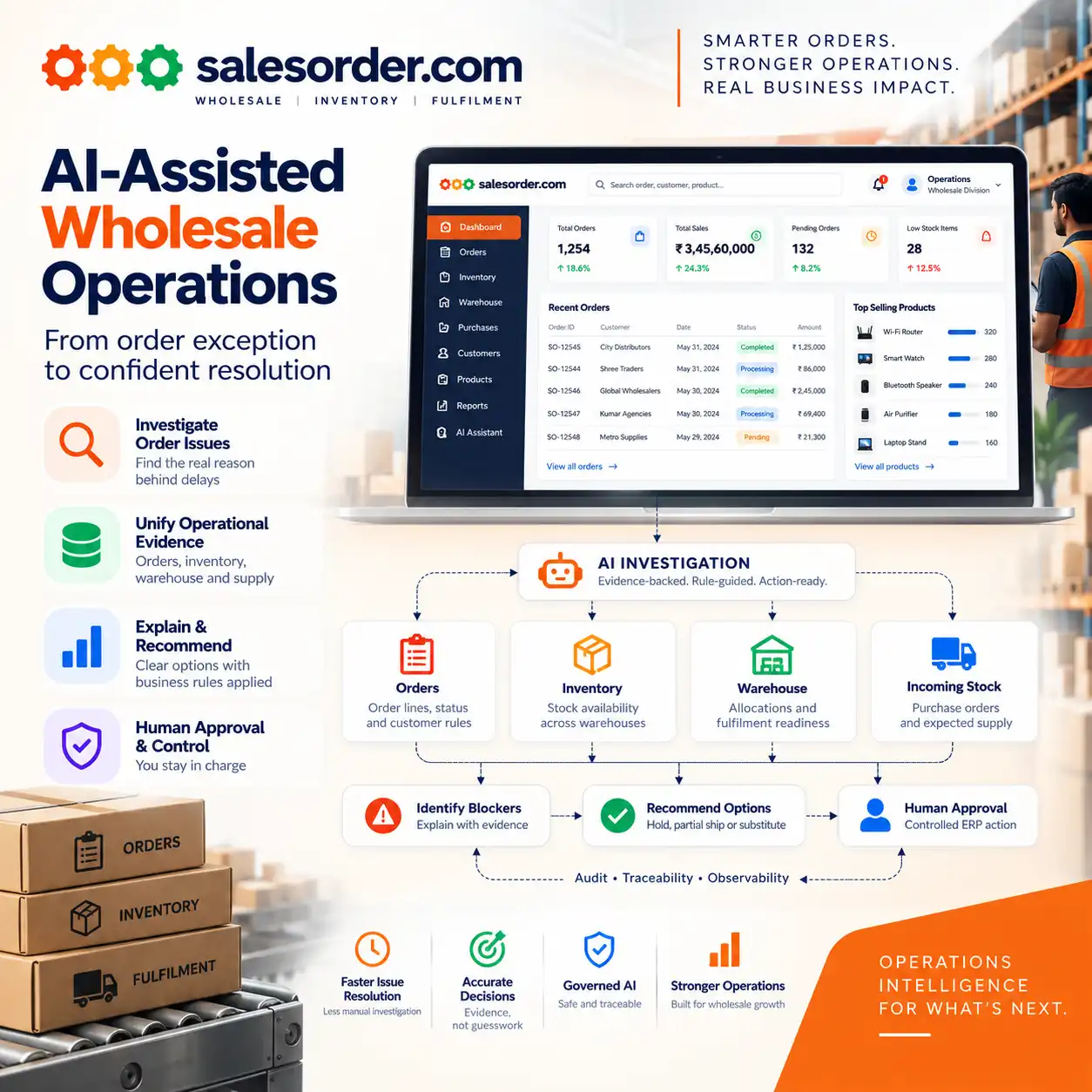
The implementation was shaped around the work employees were already doing, not around a generic AI feature list.
Orders, inventory, allocations, purchase orders, customer rules and fulfilment states remain authoritative in existing application services.
A bounded agent orchestrates purpose-specific tools so staff do not have to manually traverse every record before understanding a blocker.
AI may explain and prepare a resolution; protected order, allocation and shipment actions require role authority, approval and state revalidation.
Each proof case uses the same synthetic Salesorder data model, tool contracts, deterministic rules and evidence chain.
One line prevents full allocation; safe options are evidence-qualified
Open caseCurrent shortage and future replenishment are kept as separate operational states
Open caseAlternate stock is surfaced without silently reallocating the order
Open caseThese are planning targets for the controlled pilot, not measured production results. They define what live usage needs to validate.
Wholesale exception control path
The sequence is not a generic agent lifecycle. It follows the order exception from identity resolution through authoritative evidence, deterministic validation, human authority, state revalidation and verified ERP action.
Order, customer, lines, SKU, warehouse scope and user authority.
Inventory, allocations, incoming PO, customer policy and relevant history.
Deterministic rules establish shortage, hold and eligibility truth.
Source-linked explanation with only policy-permitted options.
Authorized user approves, rejects or escalates the prepared resolution.
Current ERP state is re-read before bounded action and result verification.
The reference environment exists to make tool behavior, rules, ground truth, failure cases, security boundaries and traces testable. Live productivity and ROI are measured later against an authorised pre-AI baseline.
Artifacts are versioned by purpose and maturity so design evidence, executed reference tests and production-required measurements are not mixed.
Primewayz AI enablement for enterprise operations